
After the publication of my second book, almost eight years ago, I went underground. At the time, I wasn’t really speaking with my family. I think of this time as benching myself, which entailed a few concrete actions, like deleting all my social media for example–but the process was far more interior than that, and therefore invisible. Honestly, I missed my family, but pride kept me from admitting that, especially to them. At the same time, I’d started to feel increasingly lonely in literary spaces, disconnected and tired, and most of all, fake.
I still said yes to readings and conferences, mostly because I was broke after a lifetime of being nihilistic about just about everything, including money, and I was fortunate enough to still be receiving invitations. I had lost sight of what really matters to me about art and writing. Now I can see I had lost track of my people, and therefore myself.
Writing persisted, as it always has, but my compass had been misplaced, somehow, and along with it, my conviction. Lately, though, I think I finally found the pocket in which it’s been hiding.
Rama Duwaji is a Syrian artist born in Texas, the state where I grew up and still reside. In a Tik Tok that shows her earnestly at work tracing lines as the curves of a face emerge, Duwaji is honoring Palestinian artist Suleiman Mansour by painting his portrait. “I was always inspired by the emotion behind his portraits,” she shares. “To me, his work is a visual protest and underlines the struggles and joys of Palestinian life. One of the really important things about his work is the way he preserves Palestinian identity in a time when it’s constantly under threat of being erased. He uses his art in an almost archival way,” she continues, before concluding with Nina Simon’s oft-quoted and always timely definition of an artist as one whose “duty it is to reflect the times.”
During my benched years, I do not feel I lived up to Nina Simone’s definition of what a writer should be. I accepted a visiting professor gig at the School of the Art Institute of Chicago, where the folks in the writing program made it clear I was their third or fourth choice, and that I was being asked because they were desperate to find someone to fill the role. Well, I was desperate too, so I didn’t care (too much), because it was a year of being paid to be in Chicago. Most importantly, it was another year I could afford to avoid going home, and therefore dodging the possibility of my family seeing how lost I was. We had drifted apart for more than one reason, all of which can be boiled down to grief, misunderstanding, and an inability to communicate across multiple insurmountable-feeling distances. Writing persisted, as it always has, but my compass had been misplaced, somehow, and along with it, my conviction. Lately, though, I think I finally found the pocket in which it’s been hiding.
I couldn’t tell you why, but I reached for my notebook eagerly for the first time in eons to jot down captions of the artworks we walked past, and suddenly language was alive again.
The SAIC gig was nice enough, and I can be grateful now for all it gave me, but in the darkly dissociative state I was in, I barely experienced it. That year was spent dodging both dentist appointments and ideation, though I did try to show up for my students, however cynically and wearily. Thank Allah, my dear family friend Tafiya Khan, an immigration lawyer in NYC, came to visit, and in addition to wanting a Chicago dog (never not delicious), she wanted to go to the Art Institute. I still remember how jolted into the present I felt, walking around with her there, for the first time in what felt like years. I couldn’t tell you why, but I reached for my notebook eagerly for the first time in eons to jot down captions of the artworks we walked past, and suddenly language was alive again. A year later, I moved back home with my family, and 5 years later, those captions have evolved into a poem entitled “At the Museum, All I See is Us.”
In the beginning of her tribute to Mansour, Duwaji says, “There is always someone you have in mind when you’re making your art.” This connects with me hard in a moment in which I have just submitted to my editor the final draft of my third collection. It is a book I am terribly proud of having written–because it is full of the people I love and why I love them. In this way, the persons I have had in mind are my own family members, both blood and chosen. This book is full of odes to, and portraits of, Bangladeshi family members, as well as close friends who span multiple backgrounds and geographies. Subsequently, it is full of the vividness of folks who I see now have navigated their own difficult paths forward, but forward nonetheless. In short, I fell back in love with my people, despite my fears that I might not be one of us.
It’s taken this long to see what seems so obvious: everyone has their own distinct and unique version of “us.”
“Us” is a concept that feels as unwieldy as “forward” can. In other words, I can admit now with less intensity that I don’t always agree with my people, and sometimes I downright can’t stand us (and vice versa–I can really be insufferable). More importantly, I can admit that I drifted as far away as I did because I felt like I was failing us. The years my people and I spent apart, though, I missed them, but I also needed the distance. Sometimes solidarity seems as real as any other pipe dream, especially when the histories and experiences we each/all contain can converge and diverge so significantly. I’ve spent the last 6 years since that day at the Art Institute determined to love the “us” I belong to, which includes my family members, but not just. It’s taken this long to see what seems so obvious: everyone has their own distinct and unique version of “us.” Which means that honoring us is to try to encompass our trials & tragedies (including with each other) & our silliness & softness, too, for the archive to which Duwaji, and her portraiture of Suleiman Mansour, are necessities. I mean to say that the full range of us, and who we are, and each of our versions of that, don’t just deserve to be written down as records–it is a need, as much as we need each other.
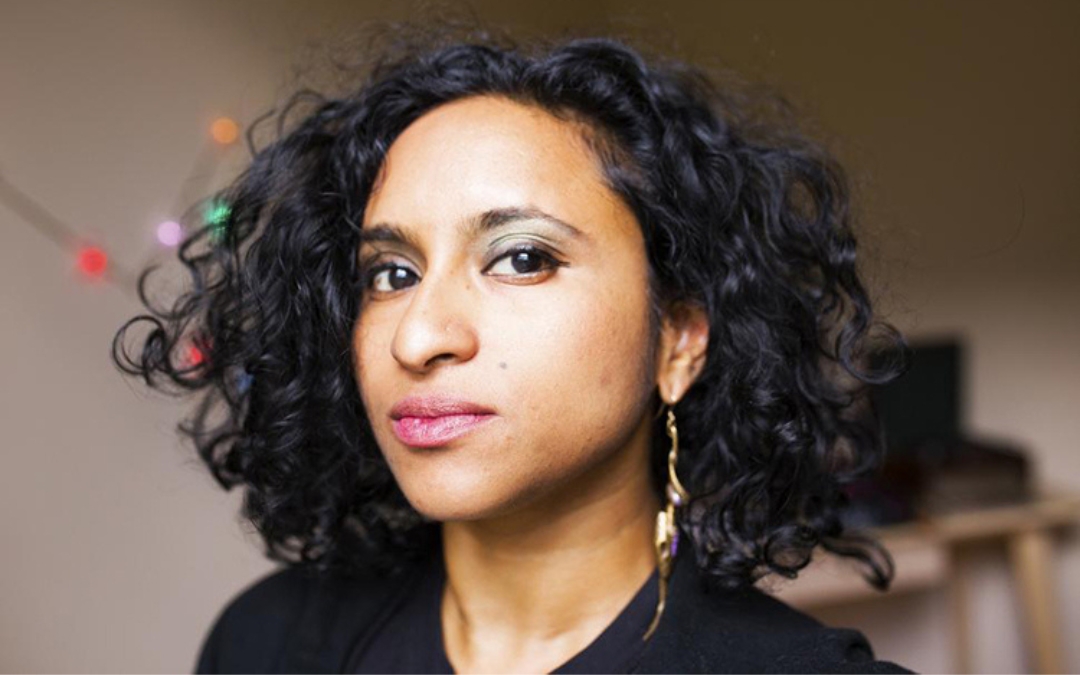
Tarfia Faizullah is the author of two poetry collections, Registers of Illuminated Villages (Graywolf, 2018) and Seam (SIU, 2014). Tarfia’s writing appears widely in the U.S. and abroad in the Daily Star, Hindu Business Line, BuzzFeed, PBS News Hour, Huffington Post, Poetry Magazine, Ms. Magazine, the Academy of American Poets, Oxford American, the New Republic, the Nation, Halal If You Hear Me (Haymarket, 2019), and has been displayed at the Smithsonian, the Rubin Museum of Art, and elsewhere.
The recipient of a Fulbright fellowship, three Pushcart prizes, and other honors, Tarfia presents work at institutions and organizations worldwide, and has been featured at the the Liberation War Museum of Bangladesh, the Library of Congress, the Fulbright Conference, the Lannan Center for Poetics and Social Practice, the Radcliffe Seminars, NYU, Barnard, UC Berkeley, the Poetry Foundation, the Clinton School of Public Service, Brac University, and elsewhere.
Tarfia’s writing is translated into Bengali, Persian, Chinese, and Tamil, and is part of the theater production Birangona: Women of War. Tarfia’s collaborations include photographers, producers, composers, filmmakers, musicians, and visual artists, resulting in several interdisciplinary projects, including an EP, Eat More Mango. In 2016, Tarfia was recognized by Harvard Law School as one of 50 Women Inspiring Change, and is a 2019 USA Artists Fellow. Born in Brooklyn, NY to Bangladeshi immigrants and raised in Texas, Tarfia currently lives in Dallas.
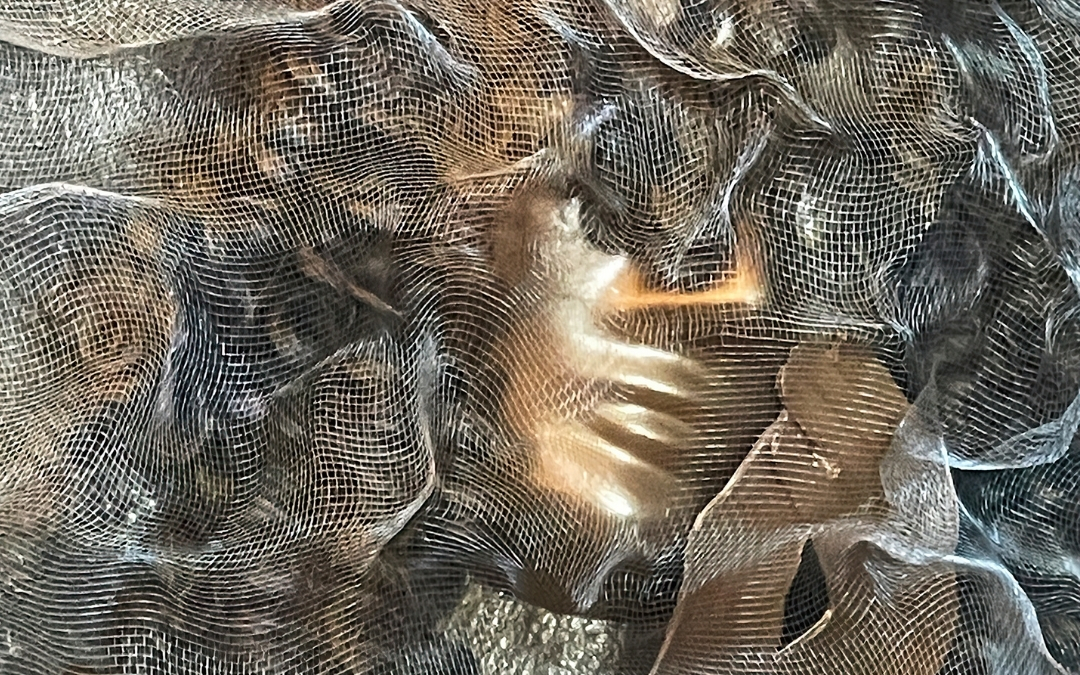
Artwork: Marie Miller, Imprisoned by F.E.A.R., 2024. Mixed Media, 28″x22″
Subscribe to our newsletter for early access to Art Saves Lives Essays!
Art Saves Lives by Community Building Art Works is a series of essays where contemporary authors, poets, and artists reflect on the sacred act of art making and allow readers to feel seen and safe to reach further inside of themselves in their own art making practice. To receive these essays in your email before they are available to the wider public, sign up for our newsletter, here.
