
My father was not a good person. Before he died, his partner contacted me to ask for medical advice, financial help, and a goodbye video call. I don’t recall another time when I felt so conflicted. Torn between respecting my boundaries and having compassion for someone whose life was fading. When the phone rang, I put on my white coat to help myself feel in control. He appeared in the frame. His scrawny body on the bed gasped for air. His frailty and the several countries between us were not enough to reassure me. I shook in fear.
I reminded myself of the reasons I decided to cut our communication six years before. I was sure that my father’s physical disappearance would be no more than the death of my abuser. Pride can be a good pretender, but it cannot drown filial love. When I first got the news about his terminal illness, it felt like ripping a bandage off burnt skin or—how we call it in medicine—exquisitely painful. I imagined him agonizing. His face, containing the cumulative sorrow I have witnessed during my years of medical practice. I did not want him to suffer, but I hoped to hear an apology from him, some sign of remorse or at least acknowledgement of what he did.
During my training to become a palliative medicine physician, I had learned how to feel comfortable with silence, how to create space for patients to express their emotions as they identify them. I learned to wait and listen, then wait a little more. But during that phone call, I was not able to hold the silence. I rushed to say that I wanted him to rest. I told him I was doing well. He opened his eyes wide in between labored breaths to see me on the screen. He recognized me. “This is the time to ask for forgiveness”, his partner, at the bedside, said to him. He mumbled, “God bless you. I never did anything to you.” For a moment, I questioned my memory. His lack of remorse shocked me. He hurt me one last time, or so I thought. I was being naïve again.
When he died, two weeks after that call, I was already exhausted from grieving him. Still, the sadness was dazing.
The motivation to improve my poems has helped me discover other poets and get out of my own mind to pay attention to what is around me, including those who love me.
I relived the trauma with millimetric rigor. I disconnected from the world, yet I yearned for a community I could lean on to bring my levitating mind back to my body. I felt like a little girl again, when I could not tell anyone what was happening, because I had not even learned the words to describe it. I was stuck in aloneness again. I didn’t know, yet, that I could write my way out of this.
I needed my mind to slow down. I began journaling my thoughts, emotions, and memories from childhood. I would write entire paragraphs on the utility of the psychoanalytic technique to approach my “case” and then curse Freud for not leaving clear instructions on how to grieve a father who was an asshole; on how to feel safe, loved, and connected after so much trauma.
Then I decided to learn more about something I had always been drawn to: poetry. I joined the online poetry workshop offered for free to healthcare workers every week by Mission Belonging led by Laura Van Prooyen. The atmosphere is kind and cozy even when it takes place in a virtual setting.
I have been participating in the workshop for over three years. From the beginning, I found myself looking forward to joining the session every week. Every attempt I have made to write a line of poetry, whether it has been good or bad, has helped me express turmoil and process trauma. The motivation to improve my poems has helped me discover other poets and get out of my own mind to pay attention to what is around me, including those who love me.
The first time I attempted to write poetry, I did so in Spanish. Now, after living and working in the United States for almost a decade, I write mostly in English. Speaking, thinking, and dreaming in a second language increases the psychological distance between me and the one who abused me. I believe that processing difficult emotions in a second language has been fundamental for my recovery.
As an adult living in a new set of circumstances, it has been my responsibility to get myself out of survival mode. An arduous daily practice.
I have been participating in the workshop for over three years. From the beginning, I found myself looking forward to joining the session every week. Every attempt I have made to write a line of poetry, whether it has been good or bad, has helped me express turmoil and process trauma. The motivation to improve my poems has helped me discover other poets and get out of my own mind to pay attention to what is around me, including those who love me.
The first time I attempted to write poetry, I did so in Spanish. Now, after living and working in the United States for almost a decade, I write mostly in English. Speaking, thinking, and dreaming in a second language increases the psychological distance between me and the one who abused me. I believe that processing difficult emotions in a second language has been fundamental for my recovery.
I love English not only because of its sound, but because it helps me connect with my inner world with less fear. It helps me compartmentalize my development to understand it better—my inner child speaks Spanish, and my adult self speaks English—I am these two speakers and an interpreter who strives to make them understand each other.
I have always loved creative writing. I also find it intimidating since I have a science background. Until recently, I had shared my drafts with only a handful of people, but I dreamed of the day I could share my experience with a broader audience. I yearn to feel connected to others, see them and be seen. I often think of other healthcare professionals who, like me, are afraid to speak about their grief and mental health struggles for fear of being stigmatized and their careers jeopardized. For them and for myself, I want to print my wounds on paper and continue writing towards recovery.
Trauma disconnects. That inner sense of profound isolation has been one of the most dangerous feelings for me and a source of great frustration to those closest to me. Genuine and deep human connection requires trust, and I can trust only when I feel safe. I barely experienced that early in life, so perhaps I never learned how to trust anyone. As an adult living in a new set of circumstances, it has been my responsibility to get myself out of survival mode. An arduous daily practice.
My attempts to become a better writer have made me more resilient. I have gotten back to work and now I wonder how my new experiences will show up in my drafts. I want more skills to write better, but what I hope for is more courage to continue this self-discovery ride. Meanwhile, I will keep a logbook of treasures and bumpy turns as tender reminders of redemption and its promise.

Monica Pernia Marin is a Venezuelan American physician and emerging poet, and winner of the 2024 Medmic Summer Poetry Contest. When she is not caring for patients, she can be found reading and writing, dancing, or exploring New York City with her dog, Lana.
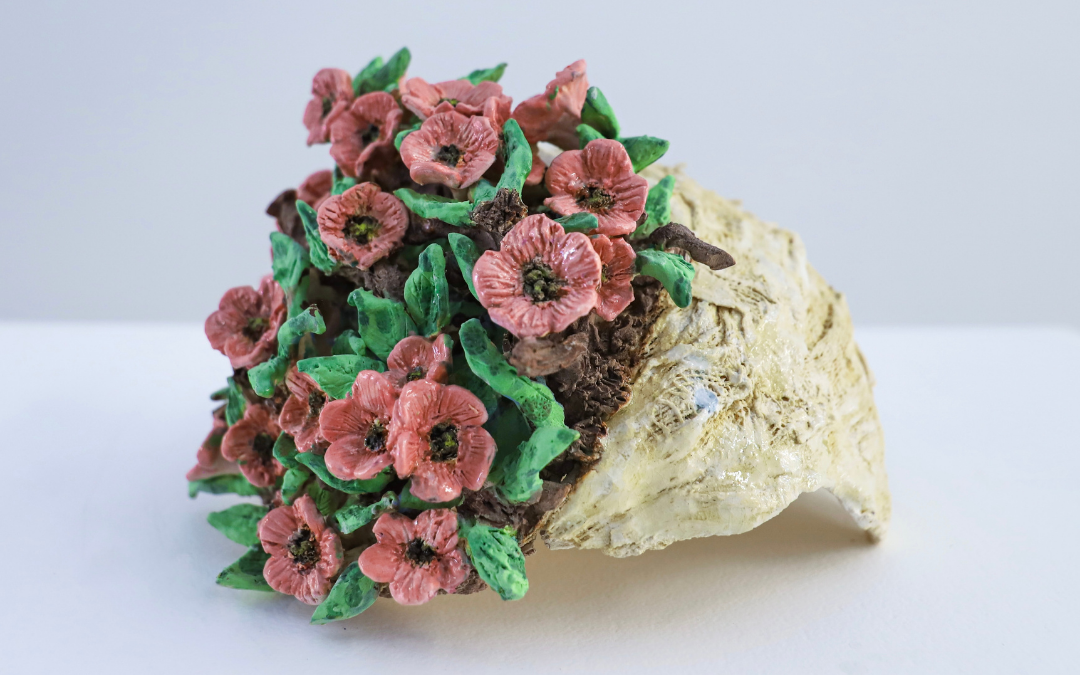
Artwork: Leslie Hidalgo
Subscribe to our newsletter for early access to Art Saves Lives Essays!
Art Saves Lives by Community Building Art Works is a series of essays where contemporary authors, poets, and artists reflect on the sacred act of art making and allow readers to feel seen and safe to reach further inside of themselves in their own art making practice. To receive these essays in your email before they are available to the wider public, sign up for our newsletter, here.
